
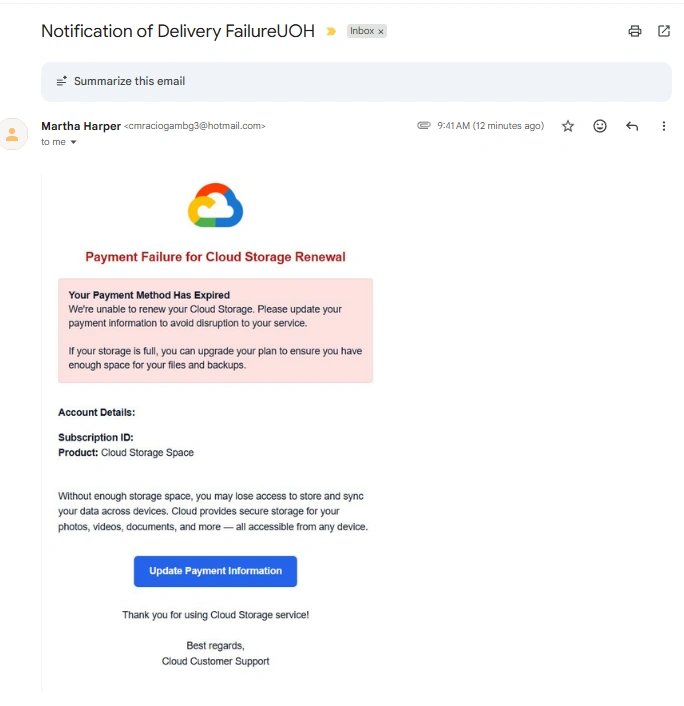
It arrived again this morning. A clean, official-looking email with the Google Cloud logo at the top, an urgent red banner, and a single bright button inviting me to “Update Payment Information.” The sender? A Hotmail address. The subject line? Deliberately vague: “Notification of Delivery FailureUOH.” Just confusing enough that you might open it to figure out what it means.
If you received an email with the subject “Notification of Delivery FailureUOH” or a message saying your cloud storage payment failed, it is a phishing scam. Do not click anything. Here is how the scam works and who is behind it.
You have seen this email. Your mother has seen it. Your coworkers have seen it. Billions of these messages flood inboxes every year, and they keep coming because they keep working. The question is not whether this is a scam. It obviously is. The real questions are: who is behind it, what do they gain, and why does it work on so many people? The answers reveal something uncomfortable about our universal dependency on cloud storage, and offer a simple insight into why some people are immune.
The Numbers: Who Clicks?
More people than you would think, and faster than you would expect. Research shows that the median time for a user to click a phishing link is just 21 seconds after opening the email. Not minutes. Not after deliberation. Twenty-one seconds, barely enough time to read the subject line and react. The average click rate on bulk phishing emails ranges from 3 to 12 percent depending on the study. When the email uses emotional urgency, like telling you your payment method has expired and your files are at risk, that rate surges past 18 percent. AI-crafted spear phishing emails now achieve click rates as high as 54 percent, a 4.5x improvement over human-written campaigns.
That baseline of 3 to 12 percent may sound small, but consider the volume. An estimated 3.8 million phishing attacks were recorded in 2025 alone. When you send millions of emails at fractions of a penny per message, even a 3 percent click rate produces hundreds of thousands of victims. Run those numbers on a campaign of just one million emails at 18 percent. That is 180,000 people clicking a malicious link from a single batch. Now multiply that across the dozens of campaigns running simultaneously worldwide, every single day.
The Payoff: Why Scammers Spend Their Time on This
The economics of phishing are staggeringly lopsided, and that asymmetry is the entire reason the industry exists. A phishing kit from a darknet marketplace costs $50 to $200. Bulk email sending for a million messages costs a few hundred dollars. Total campaign cost: under $500. A single successful Business Email Compromise attack averages over $125,000 in stolen funds. Even smaller credential-harvesting schemes, the kind where someone enters their Google password on a spoofed login page, yield credentials that sell for anywhere from a few dollars to hundreds on dark web marketplaces, depending on the account type. Multiply that across thousands of harvested accounts and the revenue is enormous.
The FBI’s Internet Crime Complaint Center reported $20.9 billion in total cybercrime losses in 2025, a 26 percent jump from the previous year. Phishing-related losses alone surged to $215.8 million, and Business Email Compromise, which almost always begins with a phishing email, accounted for over $3 billion. A campaign that costs under $500 to execute can generate five, six, or seven figures in return. That is not a gamble. That is a business model.
Who Is “They”?
It would be comforting to imagine a lone hacker in a basement. The reality is far more organized. Modern phishing operations are structured like corporations. They have divisions: developers who build the phishing kits, operators who manage the email infrastructure, designers who replicate the logos and layouts of legitimate companies, money specialists who launder the proceeds through cryptocurrency and wire transfers, and even call center teams who follow up with victims by phone to extract additional information.
These are not amateurs. They are organized crime syndicates operating across borders, with ringleaders in one country, developers in another, and money mules scattered across a third. Law enforcement agencies have identified networks operating out of Eastern Europe, West Africa, Southeast Asia, and state-sponsored groups from nations including North Korea, Russia, and China. The U.S. Department of Justice has pursued cases against groups like Saim Raza, a Pakistan-based network that sold phishing toolkits to transnational criminal organizations for years. What used to require days of planning can now be deployed within hours, thanks to AI tools that generate convincing email copy, clone website designs, and even personalize messages at scale. The barrier to entry has collapsed. The payoff has not.
Why This Specific Scam Works: The Cloud Dependency Problem
Here is where it gets interesting. Not all phishing scams perform equally. The “your cloud storage payment failed” template has become one of the most widely circulated scam formats on the internet, and the reason comes down to a single word: universality.
Approximately 2.3 billion people worldwide use consumer cloud storage services like Google Drive, iCloud, Dropbox, or OneDrive. Microsoft OneDrive and Apple iCloud alone account for roughly 39 percent of usage each. Ninety-four percent of enterprises use cloud services. Approximately 60 percent of all corporate data now lives on cloud infrastructure. This means if you send a cloud storage payment warning to a random inbox, the probability that the recipient actually uses cloud storage, and has payment information tied to it, is extraordinarily high. The scam does not need to target you specifically. The global adoption of cloud storage has done the targeting for them.
Compare this to a phishing email about, say, a niche software subscription or a regional bank. Those require careful targeting because most recipients will not have the account in question, and the irrelevance becomes a red flag. But everyone has cloud storage now. Everyone has heard of Google Drive. Everyone knows their credit card is probably on file somewhere. The scam’s power is in its sheer relatability.
The Panic Chain
Relatability alone does not cause the click. What causes the click is panic, and panic is the product of dependency. When your family photos, your tax documents, your contracts, your medical records, your children’s school files, and your work projects all live on a cloud service, the words “your payment method has expired” trigger something visceral. It is not a calm assessment of risk. It is a flash of dread: am I about to lose everything?
That 21-second median click time tells the whole story. People are not analyzing the sender address. They are not checking whether the domain matches. They are reacting to the fear of losing access to their digital life, a life that, for billions of people, exists entirely on someone else’s servers. This is the mechanism that makes cloud-storage phishing so devastatingly effective: the scam exploits a dependency that the victim did not consciously choose but cannot imagine living without.
The Immunity Test: Why Some People Do Not Flinch
Now consider the person who receives this same email but does not store sensitive data on the cloud. Their photos are on a local NAS or an external drive. Their financial documents are on their own machine, backed up locally. Their business data lives on infrastructure they control. When the email says “your cloud storage payment has failed,” the emotional response is completely different. There is no panic, because there is nothing at stake. The email is immediately recognizable for what it is: irrelevant noise from a Hotmail address.
Every cloud-storage phishing email is built on a single bet: that you have put something important enough on the cloud that the threat of losing access to it will override your judgment. If that bet is wrong, if your critical data is not there, the scam has no leverage. This is not about being smarter or more tech-savvy. Brilliant people fall for phishing every day because their emotional response to the threat is genuine. They do have critical data on cloud servers, and the prospect of losing it is real enough to short-circuit careful thinking. The person who does not flinch is not necessarily more cautious. They simply have less to lose in that particular scenario, because they have made different choices about where their data lives.
The Broader Lesson
The cloud storage phishing epidemic is, in many ways, a consequence of centralization. When billions of people converge on the same handful of storage providers and trust those providers with their most important data, they also converge on the same vulnerability. A single phishing template can exploit that shared dependency at a global scale, and the economics make it irresistible for criminal organizations to keep doing it.
This does not mean cloud storage is inherently bad. It means that the decision to put sensitive, irreplaceable, or high-value data on the cloud should be a deliberate one, made with an understanding that it comes with exposure. Every file you upload to a cloud service is another reason the next phishing email might feel urgent instead of absurd.
The strongest defense against social engineering is not a better spam filter or a sharper eye for forged logos. It is reducing the surface area of panic. When your sensitive data is not dangling on someone else’s infrastructure, the threat of “your payment failed” carries no weight. The email arrives, you glance at it, you recognize the Hotmail address, and you delete it without a second thought. That is not paranoia. That is architecture.
Sources: FBI IC3 Annual Report 2025; IBM Cost of a Data Breach Report 2025; APWG Phishing Activity Trends; U.S. Department of Justice cybercrime seizure announcements. Statistics cited from StationX, Keepnet Labs, Astra Security, Cloudwards, SQ Magazine, and Medha Cloud research compilations (2025–2026).
Related: Cloud password managers face more than just phishing. ETH Zurich researchers developed 25 successful attacks against Bitwarden, LastPass, and Dashlane, and Dashlane's 2FA was recently brute-forced by an attacker who already had user passwords. The 2022 LastPass breach exposed 30 million vaults and over $150 million in crypto has been stolen since. See Is LastPass Safe? The Breach That Keeps On Taking. If you are considering an offline alternative, see our comparison of the best offline password managers.